Despite the contents in some of the preceding chapters, my intention is not to turn these glorious travels through the world of local music into an accounting of sexual exploits. A lot of the songs I wrote in the 1990s are linked to the handful of experiences I had with women around that time. These relationships were seldom simple or customary and they led to situations that inevitably spilled over into my material. Consequently, it’s difficult to explain one without addressing the other.
Though I no longer had anything to do with Sandra Falon (see chapter 3), the time we spent together still played a part in the type of songs I was writing. Songs such as Cousin Amanda, Big Blonde, South of Duchess, Not Anytime Soon and others were inspired either by Sandra or by people I had met through her. Similarly, there were numbers that came out of my relationships with Bewildra (see chapter 9 and 10) and Lilly (see chapter 2). Often, the women were incidental and it was the environment they caused me to be a part of that produced an idea for new material.
Like so many other writers and artists, I was drawn toward the darker elements of society. My sensibility naturally leaned in that direction and finding authors like William Burroughs, Charles Baudelaire, and Charles Bukowski, only reinforced this point of view. It was my personal contact with the realities of the shadowy aspects of life that had initiated a renewed interest in songwriting. When I returned to the straight world – after breaking it off with Sandra – I occasionally went back to the other side to see if anything might prompt the beginnings of a new song.
At the time, I was shooting nightlife documentary photographs as well as attending the many stripper/drug parties being held at Jack Armstrong’s studio (see chapter 3). These outings were augmented by visits to rave dance clubs and strip clubs. The material gathered was usually spotty. There might be weeks when nothing came of all the trolling but, eventually, something would spark a thought that ended up in a song. In truth, the search for subject matter was a secondary concern to me. What I was looking for – and what I missed – was the decay that made up the world of the addict. That, and more specifically, the type of women who inhabited that world.
Rather than once again getting sucked into the madness, I now preferred to watch from a distance. When observed from the outside, degradation and decay have a very different quality than experiencing either first hand. The ugliness may be unrelenting but it can also be very moving and, if women are involved, it can turn into something tragically beautiful. Their vulnerability in these dire situations transformed them into withering, faded flowers and I found this irresistibly seductive. When I was younger, women had always been unapproachable. To now see them in such unguarded conditions was almost like a narcotic. That may sound more unpleasant than it actually was. I did feel great empathy for them but, at the same time, my voyeuristic tendencies were what motivated me. This was the real reason behind my documentary photographs as well as many of the songs that I wrote during this period.
It wasn’t always women from the lower rungs of society that caught my eye. Once, I recall crashing a black-tie benefit dinner dance held at Music Hall for the Cincinnati Symphony Orchestra. I went there to shoot pictures. Dressed in a suit and tie with a camera slung over my shoulder, no one said a word as I walked into the ballroom. I had done this sort of thing before. As long as you look the part, people will give you the benefit of the doubt. In this case, they assumed I was a photographer shooting pictures for the society pages of the local paper.
Interesting images were hard to come by at these black-tie dinners but they were wonderful events to attend. The people could not have been more polite and friendly, the music was sometimes first rate and there was usually an open bar. While wandering around looking for possible subjects, I noticed a woman I had seen at another such function; a fund-raising party at the Cincinnati Art Museum. She appeared to be in her late 50s or early 60s and, at the first event, she wore a gorgeous form-fitting black velvet gown. Regardless of her age, everything about her was alluring. She came accompanied by her husband – as they always do – but she weaved aimlessly around the Art Museum’s atrium, drink in hand, alone. Clearly plastered, she noticed me with my camera and struck several poses; a couple of which I shot.
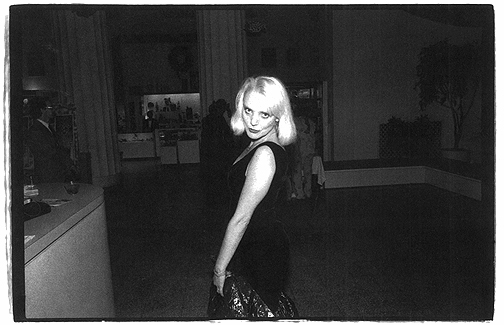
Cincinnati Art Museum (Beaux Arts Ball)
When I saw her again at Music Hall, she had put on a little weight. She was wearing a gold sequined dress and sparkling gold pumps and she was as drunk as the first time I’d seen her. I attempted to take a picture but couldn’t find the right moment. She wandered a bit, finally finding her perch on a stool at the bar. I watched her with great admiration, taking in every bit of her jaded, captivating splendor.
<<< Continue reading >>>
<<< Read the previous chapter
© 2013 by Maurice Mattei
All rights reserved.